The lights go out. Again. You check your phone Stage 6 load-shedding. The fridge hums to a stop. The Wi-Fi dies. The security system starts beeping. And you wonder: How long until I can finally take control of my power supply?
For millions of South Africans, this scene has become all too familiar. Years of load-shedding, rising electricity tariffs, and increasing grid unreliability have fundamentally changed what we expect from our homes. Solar backup systems have moved from a luxury add-on to a near-essential feature of South African homes.
This guide covers everything you need to know about solar backup system what they are, how they work, what they cost, and how to choose the right system for your home.
What Is a Solar Backup System?
A solar backup system combines solar panels, an inverter, and batteries to generate, store, and use your own electricity. It allows you to:
- Generate power from sunlight during the day
- Store excess energy in batteries for use at night or during outages
- Reduce your reliance on Eskom and municipalities
- Protect your home from load-shedding and power outages
The key distinction: A solar backup system is different from a simple grid-tied solar system. While grid-tied systems shut down during outages (for safety reasons), a solar backup system with batteries keeps your lights on when the grid goes down.
How Does a Solar Backup System Work?
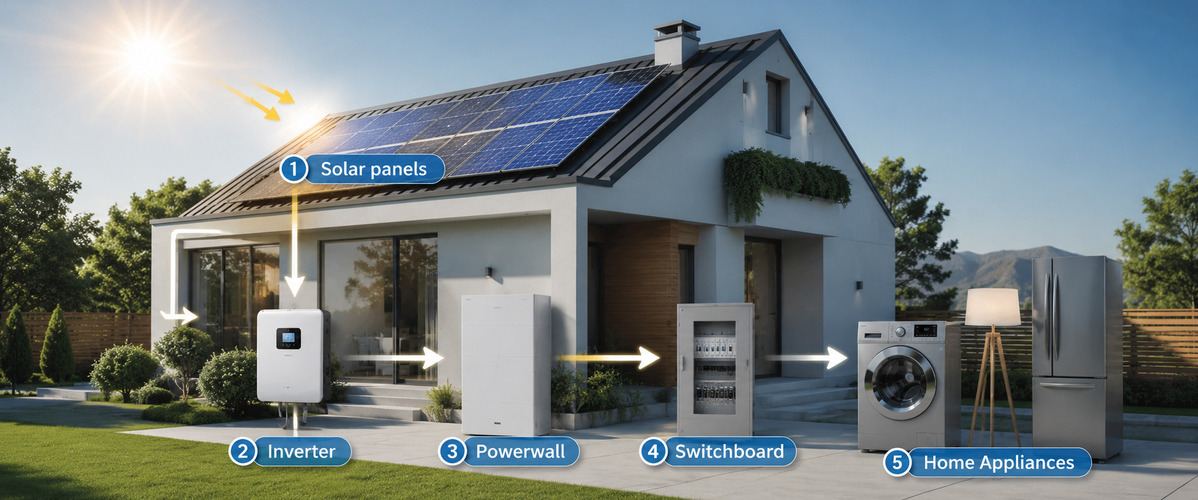
The process happens in four simple steps:
| Step | What Happens |
|---|---|
| 1. Solar generation | Solar panels convert sunlight into direct current (DC) electricity |
| 2. Conversion | The inverter converts DC electricity into alternating current (AC) electricity that your home can use |
| 3. Real-time usage | Your home draws power directly from the solar panels during the day |
| 4. Storage | Any surplus energy that isn't immediately consumed is stored in the battery bank for use at night or during outages |
During a power outage:
- The system automatically disconnects from the grid (for safety)
- The inverter draws power from the battery bank
- Your essential appliances continue to run
- If you have a hybrid system with sufficient battery capacity, you may not even notice the outage
Critical point: With a standard grid-tied solar system, your panels shut down during a power outage for safety reasons. This is why batteries are essential if you want backup power during load-shedding.
Types of Solar Backup Systems
Not all solar systems are the same. The right system for your home depends on your energy consumption, your budget, and your goals.
1. Solar + Battery (No Grid Feed-in)
The most common configuration for South African homes. Solar panels generate power during the day, charge a battery bank, and the battery powers your home during load-shedding and at night. You remain connected to the grid for additional power when needed but rely on it less.
Best for: Most suburban homes wanting load-shedding protection and reduced electricity bills
Typical system: 3kW–10kW inverter, 6–16 x 410W panels, 5kWh–20kWh battery
Cost range: R80,000–R250,000 installed
2. Hybrid Solar System (Grid-Tied with Battery)
A hybrid system feeds excess power back to the grid (where your municipality allows feed-in) and draws from the grid when solar generation and battery are insufficient. Maximises the financial return on your solar investment.
Best for: Homeowners with daytime electricity consumption and municipalities that allow feed-in tariffs (City of Cape Town, Tshwane)
Cost range: R100,000–R300,000 installed
3. Off-Grid System
Completely independent of the municipal grid. Requires significantly more panels and battery capacity to cover all consumption including cloudy days and high-usage periods. Most practical for rural or farm properties where grid connection is unavailable or prohibitively expensive.
Best for: Farms, game estates, rural properties, smallholdings
Cost range: R250,000–R800,000+ installed
For a typical 3–4 bedroom suburban home in Johannesburg, Pretoria, or Cape Town, the standard recommendation in 2026 is: 5kW hybrid inverter + 8–10 x 415W panels + 10kWh lithium battery. This covers most households through a Stage 6 load-shedding period and significantly reduces the Eskom electricity bill. Installed cost: approximately R120,000–R160,000.
Advertisement
Key Components Explained
Understanding the components of a solar system helps you evaluate quotes and compare installations meaningfully.
| Component | What It Does | Key Brands in SA | Lifespan |
|---|---|---|---|
| Solar Panels | Convert sunlight into DC electricity | JA Solar, Jinko, LONGi, Canadian Solar | 25–30 years |
| Inverter | Converts DC to AC, manages battery charging | Sunsynk, Victron, Deye, Growatt, SMA | 10–15 years |
| Battery | Stores energy for use during outages and at night | Pylontech, BYD, Freedom Won, Hubble | 8–15 years |
| Distribution Board | Routes power between grid, solar, and battery | Various (installed by electrician) | 20+ years |
How to Size Your System
Sizing your system correctly is the most important step in the process. Too small, and you'll still be in the dark. Too large, and you'll waste money.
Step 1: Calculate Your Daily Usage
Check your electricity bill for your average daily consumption in kWh. For most South African households:
| Home Size | Typical Daily Usage |
|---|---|
| 1–2 bedroom apartment | 5–10 kWh |
| 3–4 bedroom family home | 10–20 kWh |
| Large home with pool/AC | 20–30+ kWh |
Step 2: Determine What You Want to Power
Essential loads (must stay on): Fridge, freezer, lights, Wi-Fi, security system, TV, selected plugs
Non-essential loads (can go off): Geyser, pool pump, air conditioning, electric stove, washing machine
Step 3: Size Your Battery
Your battery should cover your essential loads for the duration of typical outages. The formula is:
Battery size (kWh) = Essential load (kW) × Hours of backup required
Example: If your essential loads total 2 kW and you want 8 hours of backup, you need a 16 kWh battery.
Step 4: Size Your Solar Array
Your solar panels need to generate enough power to run your home during the day, charge your battery for nighttime use, and cover periods of cloudy weather.
Rule of thumb: A 5kW solar array (12–14 panels) typically generates 20–25 kWh per day.
Costs and Savings
The Numbers: South Africa has some of the most favourable solar conditions in the world. Solar systems here produce up to 50% more energy than equivalent systems in Europe or North America. Solar energy is significantly cheaper per kWh than Eskom's residential electricity tariff, which has increased at double-digit percentages for years.
Return on Investment: A typical 5kW system with battery pays for itself in 5 to 8 years through electricity savings, making it one of the best investments available to South African homeowners.
System Sizing Examples
| System Size | Suitable For | Installed Cost | Monthly Bill Saving |
|---|---|---|---|
| 3kW + 5kWh battery | 1–2 bedroom apartment or small home | R75,000–R100,000 | R600–R1,200 |
| 5kW + 10kWh battery | 3–4 bedroom family home | R120,000–R165,000 | R1,200–R2,200 |
| 8kW + 15kWh battery | Large family home, pool, underfloor heating | R175,000–R240,000 | R2,000–R3,500 |
| 10kW + 20kWh battery | Large home, full energy independence target | R220,000–R320,000 | R2,800–R4,500 |
Prices include supply, installation, and COC. Exclude structural roof work if required. VAT included.
Financing Options
| Option | How It Works |
|---|---|
| Cash purchase | Pay upfront — lowest total cost |
| Bank loan | Financing through your bank — monthly repayments |
| Solar-specific financing | Specialised lenders offer solar loans at competitive rates |
| Power Purchase Agreement (PPA) | Pay monthly for the power the system generates — no upfront cost |
The Solar Tax Rebate
South African homeowners can claim 25% of the cost of new and unused solar panels (not batteries or inverters) as a rebate against their personal income tax, up to a maximum rebate of R15,000.
| Element | What You Need to Know |
|---|---|
| What qualifies | Solar panels only (not batteries or inverters) |
| Claim amount | 25% of panel cost, up to R15,000 |
| Who can claim | Individuals (not companies or trusts) |
| How to claim | Submit proof of purchase and COC with your tax return |
Solar and Property Value
Yes and increasingly significantly. Research by property valuers and estate agents consistently shows that a well-installed solar system adds meaningful value to a residential property.
| Factor | What the Data Shows |
|---|---|
| Added value | A 5kW system with battery adds approximately R80,000–R120,000 to property value |
| Sale speed | Properties with solar sell faster than equivalent non-solar properties |
| Market preference | In estates where solar is standard, properties without it are increasingly difficult to sell at full value |
| Luxury expectation | Luxury property buyers in 2026 treat solar and battery as non-negotiable |
Important: If your home has a solar system, it's essential to ensure that valuers are aware of it and understand its value. Some banks and valuers may undervalue or ignore solar installations if not properly documented.
Choosing a Solar Installer
Your installer is the most important decision you'll make. Here's what to look for:
| Requirement | Why It Matters |
|---|---|
| SAPVIA membership | The South African Photovoltaic Industry Association maintains a list of registered installers — this is the industry's gold standard |
| ECSA-registered electrician | The installation must be done by a registered electrician who will issue a Certificate of Compliance (COC) — without it, your home insurance may be invalidated |
| Warranties | Sunsynk and Victron inverters carry 5-year warranties; Pylontech and BYD batteries carry 10-year warranties — insist on seeing warranty documentation before signing |
| Monitoring | Most modern inverters include remote monitoring apps — insist on a system that allows you to track generation, consumption, and battery state from your phone |
Important: After the installation, your installer is legally required to issue an Electrical Certificate of Compliance (COC). Without this, your home insurance may be invalidated, and the installation is not compliant with South African regulations.
Common Mistakes to Avoid
1. Undersizing Your System
The risk: You buy a system that can't power your essential loads through an entire load-shedding period.
The fix: Calculate your actual usage. A professional installer will help you size the system correctly. Remember: 10kWh of battery capacity is roughly 8kWh of usable power.
2. Choosing Price Over Quality
The risk: The cheapest quote often means cheaper components — panels, batteries, inverters — with shorter lifespans.
The fix: Compare quotes carefully. Pay attention to component brands and warranties. A lower upfront cost may end up costing you more in the long run.
3. Ignoring the Battery Chemistry
The risk: Old battery types like lead-acid have much shorter lifespans and lower depth of discharge.
The fix: Specify lithium batteries. LiFePO4 batteries last significantly longer and can be discharged deeper, meaning you get more usable power from the same capacity.
4. Not Planning for the Future
The risk: You install a system that can't be expanded to meet growing needs.
The fix: Choose a system that is expandable hybrid inverters are usually expandable and can take additional batteries in the future.
5. Not Getting a COC
The risk: Your home insurance is invalidated. Your installation is not compliant with South African regulations.
The fix: Insist on a Certificate of Compliance from your installer. This is non-negotiable.
- A 5kW system with 10kWh battery suits most South African family homes — installed cost R120,000–R165,000, monthly saving R1,200–R2,200
- Solar prices have fallen significantly since 2022 — 2026 is one of the best times in South African history to install solar
- The solar tax rebate covers 25% of panel costs up to R15,000 — claim it on your personal income tax return
- A well-installed system adds R80,000–R120,000 to property value and helps properties sell faster
- Use a SAPVIA-registered installer and insist on a Certificate of Compliance — essential for insurance validity
- Compare at least 3 quotes — prices and component quality vary significantly between installers